
.png)

%20(1).png)
-1.png?width=40&name=Empowering%20Transformation%20-%20logo%20transition%20animation%20(7)-1.png)
.png)
Reality capture technology has been part of the AECO conversation for years. But for MEP consulting firms, adoption has historically been slower than it should be — partly because the early tools were complex, expensive, and hard to integrate into existing workflows.
That's changed. Matterport has become the go-to reality capture platform for MEP teams across Canada, and not because it's the flashiest technology on the market. It's because it fits directly into how MEP engineers already work — and solves problems they deal with on every project.
Here are five ways MEP teams are using Matterport on active projects right now.
1. Documenting Existing Mechanical Systems Before Design Begins
Every renovation or retrofit project starts with the same fundamental question: what's already there? For MEP teams, that question covers a lot of ground — mechanical rooms, pipe runs, ductwork routing, electrical infrastructure, ceiling plenum conditions, and the dozen other things hidden behind walls, above ceilings, and below floors.
Traditional documentation methods — site visits, manual measurement, photography — produce data that's inconsistent at best and dangerously incomplete at worst. A single missed dimension or unrecorded obstruction can cascade into costly design changes once construction begins.
Matterport allows MEP teams to capture the full spatial conditions of an existing facility in a single scanning session. The result is a complete, navigable 3D model that the entire project team can reference remotely — without scheduling another visit to verify conditions that were already captured.
HH Angus, one of Canada's leading MEP consulting engineering firms, uses Matterport to document existing conditions across healthcare, commercial, and institutional projects. Their teams can walk through a captured space remotely and verify conditions at any point in the design process — without leaving the office.
2. Verification of Coordination Models Before Fabrication
One of the most expensive mistakes in MEP construction is discovering a clash or coordination error after fabrication has started. By that point, the cost isn't just the rework — it's the schedule delay, the subcontractor disruption, and the client conversation that follows.
BIM coordination models are only as good as the data they're built on. When existing condition data is inaccurate or incomplete, coordination models inherit those errors — and the project pays for it downstream.
MEP teams using Matterport are integrating their scan data directly into their coordination workflow. By overlaying the Matterport model with their Revit or ACC model, they can identify discrepancies between design intent and actual field conditions before fabrication begins — not after.
This isn't a theoretical benefit. It's a measurable reduction in coordination RFIs, change orders, and construction-phase rework that shows up on every project where this workflow is implemented.
3. Reducing Site Visits on Active Transit and Infrastructure Projects
Transit and infrastructure projects present a particular challenge for MEP teams: the sites are often operational, access is restricted, and every site visit requires coordination, safety protocols, and scheduling that adds time and cost to an already complex project.
Matterport changes the economics of site access on these projects. Rather than sending multiple team members to the site for every design query or field verification, the project team can reference a captured 3D model of the space — complete with measurements, spatial relationships, and visual context — without anyone physically returning to the site.
For transit projects where shutdowns or access windows are limited, this is a significant operational advantage. A single well-timed scanning session can replace dozens of follow-up site visits across the life of a project.
The goal isn't to eliminate site visits entirely — it's to make every visit count. Matterport ensures that when your team does go to the site, they're there for the work that actually requires their physical presence.
4. Capturing Existing Conditions on Energy and Mechanical Retrofit Projects
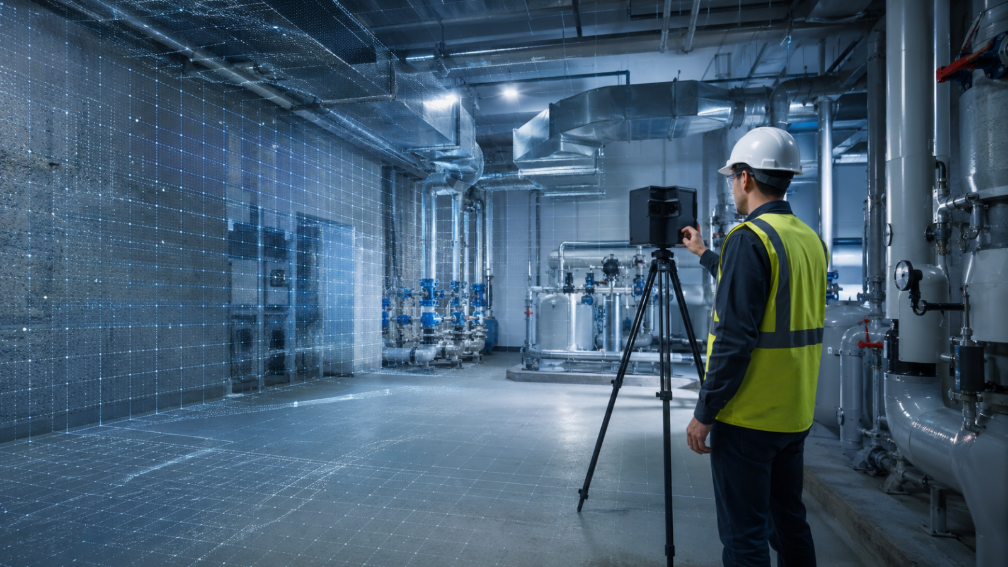
Energy retrofit and mechanical system upgrade projects are among the most documentation-intensive work in MEP project delivery. Existing systems are often undocumented, as-built drawings don't reflect decades of modifications, and the spaces involved — mechanical rooms, plant rooms, chiller installations — are dense, complex, and physically difficult to document manually.
Matterport excels in exactly these environments. A single scan of a mechanical room captures every visible pipe, fitting, valve, and piece of equipment with the spatial accuracy that MEP designers need to plan around existing infrastructure without guessing.
Energy retrofit firms using Matterport report meaningful reductions in the time required to move from site survey to design concept — because their teams are working from complete, accurate data from day one, not filling gaps with assumptions.
5. Building a Permanent Digital Archive for Long-Term Client Relationships
MEP consulting firms with strong repeat client relationships — particularly in healthcare, institutional, and commercial sectors — are using Matterport to build something that extends well beyond any single project: a permanent digital archive of their clients' facilities.
Every time a facility is scanned, that data becomes a reference point for every future project at that location. Renovation planning, infrastructure upgrades, emergency response documentation, compliance verification — all of it becomes faster and more accurate when there's a reliable baseline of existing conditions to work from.
For clients managing large facility portfolios, this is a service offering that creates genuine, ongoing value. For MEP firms, it deepens client relationships and creates a natural recurring engagement around facility documentation and updates.
The Common Thread: Better Data, Fewer Surprises
Across all five of these use cases, the underlying value is the same. Matterport gives MEP teams access to existing condition data that is more accurate, more complete, and more accessible than anything produced by traditional documentation methods.
That data advantage compounds across the project lifecycle. Better input data means better design decisions, fewer coordination errors, fewer change orders, and fewer of the schedule-threatening surprises that MEP project managers spend their careers trying to avoid.
The firms that are winning on complex renovation and retrofit projects aren't just working harder — they're starting with better information. Reality capture is how they get it.
SolidCAD is Canada's Matterport reseller for AECO and MEP consulting firms. We support teams from initial workflow evaluation through to hardware procurement, training, and ongoing scanning services. HH Angus is one of our longest-standing MEP clients — read their story to see what a Matterport-powered workflow looks like in practice.
Ready to See Matterport in Your MEP Workflow?
Book a 30-minute Matterport Workflow Consultation with a SolidCAD specialist. We'll walk through your project types, your current existing condition process, and give you an honest picture of where Matterport fits.
No obligation. Just a real conversation with someone who knows MEP workflows.
Book a Matterport Workflow Consultation
Frequently Asked Questions About Reality Capture for MEP
What is reality capture in MEP projects?
Reality capture is the process of digitally documenting a physical space using 3D scanning technology like Matterport. For MEP teams, it creates a complete, navigable 3D model of existing mechanical, electrical, and plumbing conditions — including pipe runs, ductwork, electrical infrastructure, and plenum spaces — that the whole project team can reference remotely, without repeat site visits.
How does Matterport help with MEP coordination?
By overlaying a Matterport scan with a Revit or Autodesk Construction Cloud (ACC) coordination model, MEP teams can compare design intent against actual field conditions before fabrication begins. This surfaces clashes and discrepancies early, reducing coordination RFIs, change orders, and construction-phase rework.
Can reality capture reduce site visits on active projects?
Yes. A single scanning session captures measurements, spatial relationships, and visual context that the team can reference remotely for design queries and field verification. This is especially valuable on operational transit and infrastructure sites where access is restricted, so teams reserve physical visits for work that genuinely requires being on site.
Is Matterport accurate enough for MEP design and documentation?
Matterport captures existing conditions with the spatial accuracy MEP designers need to plan around infrastructure like pipes, fittings, valves, and equipment without guessing. It is particularly effective in dense, hard-to-document environments such as mechanical rooms, plant rooms, and chiller installations where as-built drawings are often outdated or missing.
What types of MEP projects benefit most from reality capture?
Renovation and retrofit projects, energy and mechanical system upgrades, and transit and infrastructure work benefit most — any project that starts with the question "what's already there?" Firms with repeat clients in healthcare, institutional, and commercial sectors also use it to build a permanent digital archive of client facilities for future projects.
Does SolidCAD provide Matterport support in Canada?
Yes. SolidCAD is Canada's Matterport reseller for AECO and MEP consulting firms, supporting teams from initial workflow evaluation through hardware procurement, training, and ongoing scanning services.
Unlock expert insights: connect with SolidCAD today!
Discover how SolidCAD Insights can accelerate your business growth and transformation. From industry trends to practical strategies, our experts are here to help. Contact us today to discuss your needs and explore solutions tailored to your business.
%20(3).png)