
.png)

%20(1).png)

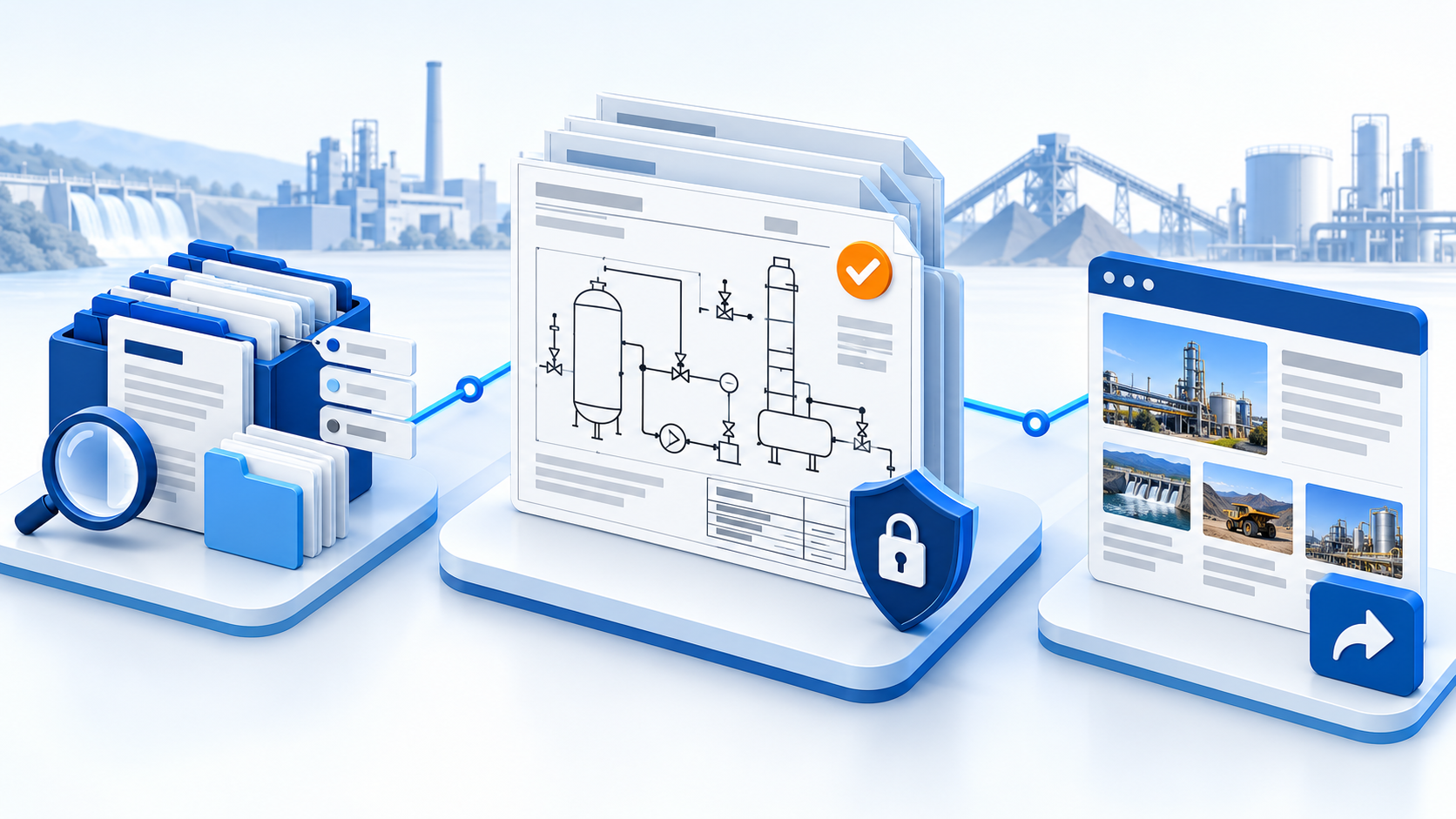
Document management, document control, and content management are related but different disciplines. Document management captures, stores, organizes, and retrieves documents and their metadata. Document control governs how controlled documents are reviewed, approved, revised, and released. Content management creates and publishes digital content, such as web pages, to an audience. An engineering document management system (EDMS) such as Accruent Meridian 2025 brings document management and document control together for technical and engineering information.
Document Management, Document Control and Content Management: Are They Really the Same?
Businesses today use multiple platforms to manage documents, engineering information, digital assets, records, data, and web content. As organizations modernize their information architecture, three terms frequently appear together:
- Document Management (DM)
- Document Control (DC)
- Content Management (CM)
Although these disciplines overlap, they are not the same.
The distinction becomes particularly important in engineering, energy, manufacturing, mining, utilities, life sciences, pharmaceutical, transportation, government, and other highly regulated environments where an organization must know not only where a document is, but also which version is approved, who changed it, why it changed, who reviewed it, and whether it is the official document of record.
This is where an Engineering Document Management System (EDMS) such as Accruent Meridian 2025 becomes different from a general-purpose Content Management System (CMS).
Meridian is designed specifically to manage technical documents, drawings, engineering information, metadata, relationships, revisions, workflows, and access throughout the document lifecycle. Accruent describes Meridian as an EDMS that provides centralized management of engineering documentation and drawings, revision and workflow management, collaboration, security, audit trails, and integration with enterprise systems. (Accruent Customer Center)
The key question for organizations is therefore not simply:
“Do we need a document management system?”
The better question is:
“Do we need to manage information, control documents, publish content, or do all three?”
What Is Document Management?
Document Management is the broader discipline of capturing, storing, organizing, securing, retrieving, sharing, and maintaining electronic documents and their associated metadata.
A document management strategy can apply to many types of information, including:
- Office files: Microsoft Word documents, Excel spreadsheets, PowerPoint presentations, PDF documents
- Engineering and technical: CAD drawings, engineering specifications, technical manuals
- Business documents: contracts, procedures, reports, forms, project documentation
- Scanned and image files: scanned documents, images
A Document Management System (DMS) provides the technology used to perform these activities. A modern DMS can provide capabilities such as:
- Storage and retrieval: centralized document repositories, metadata management, version and revision management, search and retrieval, document relationships
- Control and compliance: security and access control, document review and approval, audit trails, electronic signatures, retention and disposition
- Collaboration and integration: workflow, collaboration, integration with ERP, EAM, CRM, CAD, and other enterprise applications
The objective is to ensure that people can find the information they need and that the organization can manage that information throughout its useful life.
What Is Document Control?
Document Control is more specific than Document Management.
Document Control is the set of policies, procedures, rules, roles, workflows, and controls used to ensure that documents are created, reviewed, approved, revised, distributed, and retained correctly.
In other words:
Document Management manages the information. Document Control governs how controlled documents change.
This distinction is particularly important for engineering and regulated environments. For example, consider an engineering drawing for a processing facility. A document management system can store the drawing. Document control determines:
- Creating and changing: Who can create the drawing? Who can modify it? Can the document be changed again without initiating a controlled revision?
- Review and approval: What revision number should it receive? Who must review the revision? Who can approve it? When does the revision become effective?
- Status and history: Which version is the current approved version? What happens to the previous revision? Can an obsolete revision still be accessed for historical purposes?
- Distribution and evidence: Who received the new revision? What audit evidence exists showing the change?
That is Document Control.
Accruent similarly describes document control as the systematic management of documents throughout their lifecycle, including creation, approval, distribution, and storage. (Accruent)
Document Management vs. Document Control
The easiest way to understand the difference is to think about storage versus governance.
|
Capability |
Document Management |
Document Control |
|
Store documents |
Yes |
Yes |
|
Search documents |
Yes |
Yes |
|
Manage metadata |
Yes |
Yes |
|
Access control |
Yes |
Yes |
|
Version history |
Usually |
Essential |
|
Revision control |
Sometimes |
Essential |
|
Formal approval |
Sometimes |
Essential |
|
Controlled workflows |
Sometimes |
Essential |
|
Change management |
Limited to advanced systems |
Core capability |
|
Audit trail |
Common |
Essential |
|
Document status |
Common |
Critical |
|
Controlled distribution |
Sometimes |
Core capability |
|
Obsolete document management |
Sometimes |
Essential |
|
Regulatory evidence |
Possible |
Core objective |
|
Engineering change control |
Limited |
Core capability |
|
Official document of record |
Not always |
Central objective |
This is why a general-purpose file repository should not automatically be considered a document control system.
How Accruent Meridian 2025 (EDMS) Fits into the Picture
Accruent Meridian 2025 is positioned as an Engineering Document Management System rather than simply a digital file repository.
Meridian distinguishes between a document and its contents. A Meridian document includes the file content together with its metadata container, allowing the system to manage information about the document as well as the file itself. (Accruent Customer Center)
This distinction is important in engineering environments. A drawing is not simply P-101.dwg. It may also have:
|
Identification |
Engineering context |
Control and history |
|
Document number |
Discipline |
Author |
|
Title |
Project |
Approver |
|
Revision |
Asset |
Effective date |
|
Status |
Equipment number |
Security |
|
Document type |
Location |
Workflow state |
|
Classification |
Related documents, equipment and work orders |
Revision history |
The file is only part of the information. The document container, metadata, relationships, workflow, history, and controls provide the context required to manage the information as an enterprise asset.
Meridian 2025 and Revision Control Software
One of the most important differences between ordinary document management and engineering document control is revision management.
In Meridian, documents move through controlled workflow states and transitions when they are revised. A released document is not simply overwritten. A controlled change process creates a new revision while maintaining the history of previous revisions. (Meridian 360 Help)
Meridian 2025 also provides configurable document-type workflows. Organizations can configure workflow stages covering initiation, work in progress, review, and approval. The workflow can be designed around the organization’s revision process. (Meridian 360 Help)
This creates an important distinction:
File replacement:
Old file → New file
Controlled document revision:
Revision 01 → Change → Review → Approval → Revision 02 → Release → Historical Revision 01 retained
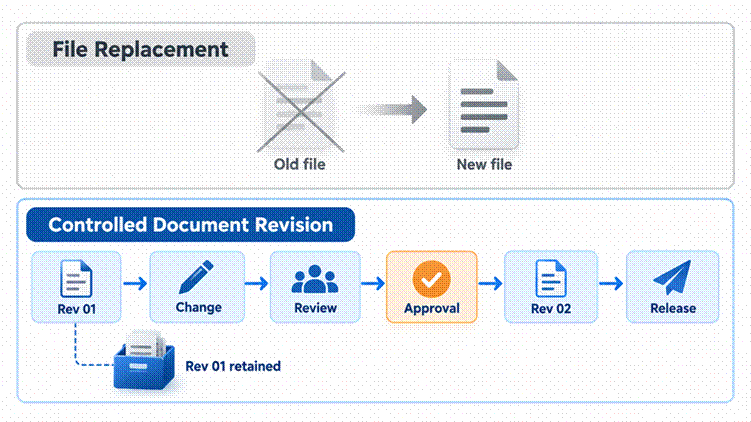
The second model provides significantly stronger document control.
What Is a Content Management System (CMS)?
Content Management is the discipline of creating, organizing, managing, publishing, and governing digital content. Content can include:
- Web and editorial: web pages, articles, blogs, marketing content, product information, knowledge content
- Media: images, videos, audio, digital media
- Structured formats and files: HTML, XML, JSON, documents
A Content Management System (CMS) is generally optimized for creating and publishing digital content to an audience.
A website is a good example. A marketing team may create a web page, send it through editorial review, publish it, update it, and republish it. The content is expected to evolve continuously.
That is different from an engineering drawing where a specific revision may become an approved document of record and remain historically significant.
Document Management vs. Content Management
The difference can be summarized this way:
- Document Management is primarily concerned with managing documents and information throughout their lifecycle.
- Content Management is primarily concerned with creating, organizing, managing, and delivering digital content to users or audiences.
A CMS may manage a web page such as www.company.com/services. The page could be edited several times a day.
A DMS or EDMS may manage P-101, Process Flow Diagram, Rev 7. The organization may need to demonstrate exactly what Rev 7 contained, who approved it, when it became effective, and what Revision 8 subsequently changed.
Both are "content," but they have very different business requirements.
Document Management vs. Content Management: Data Types
|
|
Document Management / EDMS |
Content Management / CMS |
|
File formats |
PDF, DOCX, XLSX, PPTX, TXT, DWG, DGN, CAD files |
HTML, XML, JSON |
|
Typical content |
Technical specifications, engineering drawings, manuals, procedures, reports, scanned documents |
Web pages, images, video, audio, marketing content, digital media, web components |
There is substantial overlap. A PDF can exist in both systems. The difference is how the organization needs to manage that PDF.
A marketing PDF may simply need to be published on a website. An engineering PDF may need controlled revision, formal approval, security, audit history, document relationships, and retention.
Document Management vs. Content Management: Primary Purpose
|
Area |
DMS / EDMS |
CMS |
|
Primary objective |
Manage documents and information |
Create and publish content |
|
Lifecycle |
Controlled document lifecycle |
Content publishing lifecycle |
|
Revision |
Formal revision control |
Content updates |
|
Approval |
Controlled approval |
Editorial approval |
|
Audit |
Detailed document history |
Publishing/edit history |
|
Metadata |
Highly structured |
Often flexible |
|
Relationships |
Documents, assets, equipment, projects |
Pages, media, content components |
|
Compliance |
Often a major requirement |
Usually secondary |
|
Distribution |
Controlled distribution |
Web/digital publication |
|
Users |
Engineering, operations, records, document control |
Marketing, communications, web teams |
|
Example |
Engineering drawing |
Corporate website |
Where Does Document Control Fit?
Document Control sits between Document Management and Business Process Management. It takes the information stored in the DMS and applies business rules to it. For example:
Document → Metadata → Revision → Workflow → Technical Review → Approval → Release → Distribution → Current Document of Record → Future Revision → Historical Record
This is why Document Control is not simply "having folders and naming files correctly." It is an operational control framework.
Meridian 2025 as a Document Control System
Meridian provides capabilities that support this controlled lifecycle. These include:
Revision Management
Meridian maintains document revisions rather than simply replacing the previous file. Released documents can be revised through controlled workflows. (Meridian 360 Help)
Workflow
Meridian 2025 provides configurable document-type workflows covering initiation, work in progress, review, and approval. (Meridian 360 Help)
Auditability
Meridian provides audit trails and document history to support traceability and compliance. Accruent identifies comprehensive audit trails and controlled document changes as key Meridian capabilities. (Accruent)
Security
Access can be controlled according to users, roles, document types, and organizational requirements.
Metadata
Metadata can be managed alongside document content, providing structured information about the document rather than relying exclusively on file names and folder structures.
Document Relationships
Engineering documents can be related to assets and other engineering information, helping organizations establish a connected information environment.
Controlled Change
Meridian supports managed changes to master documents, including scenarios involving concurrent engineering. Changes can be made in project areas and subsequently released as new master revisions. (Meridian 360 Help)
Search and Retrieval
Meridian Explorer provides capabilities to browse repositories, search documents and tags, search text within documents, save searches, and access document information. (Meridian 360 Help)
Document Management, Document Control and Content Management in Real Life
Consider a company with 1,500 employees operating manufacturing facilities and engineering projects. The organization implements three complementary capabilities.
Document Management / EDMS
The EDMS manages engineering drawings, equipment documentation, technical manuals, project documentation, maintenance documentation, procedures, specifications, and inspection documents.
The system captures metadata, manages document relationships, provides search, maintains revisions, and provides controlled workflows.
Document Control
Document Control governs:
- Numbering and status: document numbering, revision numbering, document status
- Review and change: review requirements, approval requirements, change control
- Release and records: release of official documents, distribution, obsolete documents, document history, audit requirements
The objective is to ensure that employees are using the right document at the right revision.
Content Management
The CMS manages corporate web pages, employee communications, marketing content, images, videos, news articles, web content, and digital publications.
The objective is to create, manage, personalize, and publish content efficiently.
A Simple Example: An Engineering Drawing vs. a Website Page
Consider two pieces of information.
Example 1: Engineering Drawing
Drawing: P-101 | Title: Process Flow Diagram | Revision: 07 | Status: Released
The organization needs to know:
- The change: What changed? Who made the change? What was Revision 06, and can it still be retrieved?
- Review and approval: Who reviewed it? Who approved it? Was the document formally approved? When was it released?
- Current use: Which revision is currently valid? Which equipment does the drawing relate to? Who has access?
This is a Document Control problem supported by an EDMS/DMS.
Example 2: Website Page
Page: Company Services
The organization needs to know:
- Who authored the page?
- What content should appear?
- Who reviewed it?
- When should it be published?
- Which images should be displayed?
- How should the page appear on mobile devices?
- How should search engines index it?
This is primarily a Content Management problem.
The two systems manage digital information, but their business objectives are different.
What About Collaboration?
Collaboration is another area where DMS, EDMS, and CMS capabilities overlap. Modern organizations may need multiple people to work on information simultaneously. However, collaboration does not eliminate the need for control.
In an engineering environment, collaboration may occur while a document is Under Change, followed by technical review and approval before the new revision becomes the released document.
Meridian supports configurable workflows for document changes, including options for forwarding documents under change when multiple users need to collaborate on the same revision. (Meridian 360 Help)
This provides an important principle:
Collaborate while the document is being developed; control it when the document becomes official.
What About External Contractors?
Engineering organizations frequently exchange information with contractors, consultants, EPC companies, suppliers, and regulators. This creates another document control challenge.
Simply emailing files back and forth creates risks such as:
- Duplicate documents
- Missing revisions
- Uncontrolled copies
- Unknown approval status
- Manual re-entry
- Inconsistent metadata
- Limited auditability
Meridian’s ecosystem supports controlled collaboration with external parties. Meridian Portal, for example, provides project roles such as Contractor, Reviewer, Approver, Contributor, Document Controller, and Project Owner, along with workflow, compliance checks, review, approval, release, and audit capabilities. (Accruent Customer Center)
This allows external collaboration to become part of the controlled document lifecycle rather than an uncontrolled email exchange.
DMS vs. EDMS vs. CMS
The terminology can become confusing, so here is a practical way to distinguish the three.
For a deeper look, read our guide Engineering Document Management Systems (EDMS): What They Are, How They Work, and Who Needs Them.
|
System |
Best suited for |
Examples |
|
DMS: Document Management System |
Managing business documents and their metadata throughout their lifecycle |
Policies, contracts, reports, procedures, correspondence, office documents |
|
EDMS: Engineering Document Management System |
Managing technical and engineering documents, drawings, assets, relationships, revisions, workflows, and controlled engineering information |
This is where Accruent Meridian 2025 fits |
|
CMS: Content Management System |
Creating, managing, organizing, and publishing digital content |
Websites, web pages, marketing content, images, video, digital publications |
Why Meridian Is Different from a Generic File Repository
- A shared file system answers the question: Where is the file?
- A basic DMS answers: Where is the document and what information describes it?
- A Document Control system answers: Is this the correct approved version, and how did it get here?
- An EDMS such as Meridian goes further: What document is this, what asset or engineering information does it relate to, what revision is current, what changes occurred, who reviewed and approved them, what is its status, and how should it be controlled throughout its lifecycle?
That distinction becomes increasingly important as organizations move from simple file storage toward enterprise information governance.
Meridian 2025 and the "Single Source of Truth"
One of the major objectives of an EDMS is establishing a reliable source for official engineering information.
Accruent describes Meridian as providing a centralized repository and a single source of truth for engineering documentation, while also integrating with systems such as EAM, ERP, ECM, Microsoft Office, and CAD applications. (Accruent)
This does not necessarily mean that every piece of corporate content belongs in Meridian. Instead, Meridian can serve as the system of record for controlled engineering information, while other platforms remain authoritative for other types of information. For example:
|
Information |
Potential System of Record |
|
Engineering drawings |
Meridian |
|
Equipment documentation |
Meridian |
|
Engineering change history |
Meridian |
|
Official engineering document revisions |
Meridian |
|
Asset information |
EAM |
|
Financial transactions |
ERP |
|
Customer information |
CRM |
|
Website content |
CMS |
|
Marketing assets |
DAM/CMS |
|
Corporate records |
DMS/ECM |
The goal is not to put everything into one application. The goal is to establish clear ownership and governance of information across the enterprise.
The Real Difference: Lifecycle
Ultimately, the biggest difference between Document Management, Document Control, and Content Management is lifecycle management.
Content Management Lifecycle
Create → Edit → Review → Publish → Update → Republish
Document Management Lifecycle
Capture → Classify → Store → Use → Update → Archive → Retain/Dispose
Controlled Document Lifecycle
Create → Draft → Review → Approve → Release → Distribute → Revise → Reapprove → Supersede → Retain
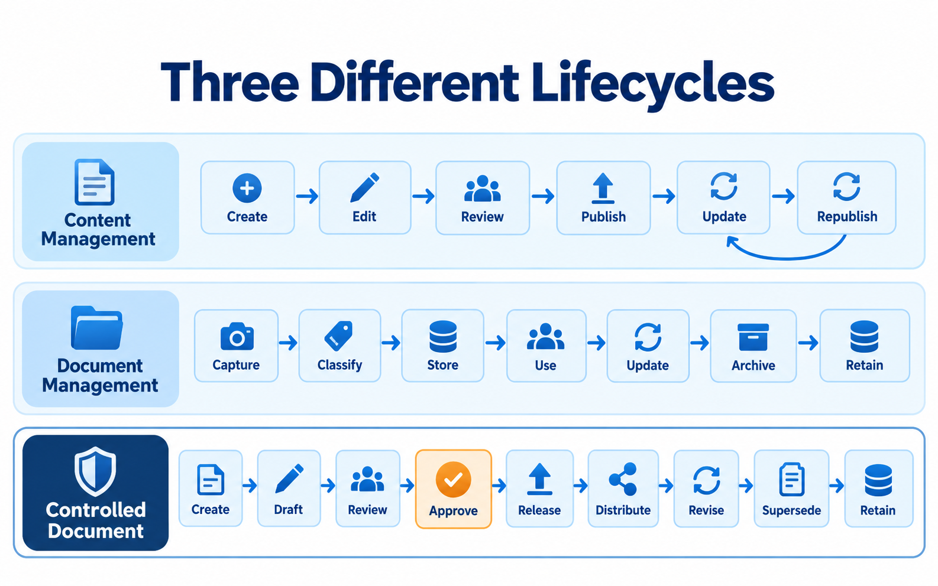
The controlled document lifecycle is much more rigorous because the organization must preserve the integrity and traceability of the information.
When Should You Use a DMS, EDMS, Document Control System or CMS?
Ask these questions.
Choose a DMS when:
- You need centralized document storage.
- You need metadata and search.
- You need document versioning.
- You need document security.
- You need workflow and approvals.
- You need electronic records management.
Choose an EDMS when:
- You manage engineering drawings.
- You manage technical documentation.
- Documents are related to physical assets.
- Revision control is critical.
- Engineering change management is required.
- Document relationships are important.
- Regulatory compliance is a major consideration.
- You need a controlled engineering document lifecycle.
Focus heavily on Document Control when:
- Documents are regulated.
- Formal approvals are required.
- Every revision must be traceable.
- Only approved versions may be used.
- Obsolete documents must be controlled.
- Document status is important.
- Auditors need evidence of document changes.
- Engineering change processes must be enforced.
Choose a CMS when:
- Your primary objective is publishing content.
- You manage websites.
- You manage digital media.
- Marketing and communications are major users.
- Content changes frequently.
- Web presentation and publishing are more important than formal document revision control.
The Future: Connecting DMS, Document Control and CMS
The future of enterprise information management is not necessarily about selecting one system to replace everything else. Instead, organizations are increasingly connecting specialized systems through APIs, integrations, workflow platforms, search technologies, and shared metadata models. For example:
|
System |
Manages |
|
CMS |
Web and Digital Content |
|
DMS / ECM |
Corporate Documents and Records |
|
Meridian EDMS |
Engineering Documents, Drawings and Asset Information |
|
EAM / ERP / CRM |
Operational and Business Data |
These systems can be integrated to create a broader enterprise information ecosystem.
Meridian provides APIs and integrations that can connect engineering information with systems such as EAM, ERP, CMMS, and GIS, including relationships between assets and documents. (Accruent Customer Center)
Conclusion
Document Management, Document Control, and Content Management are related, but they are not interchangeable.
- Document Management focuses on managing documents and information.
- Document Control focuses on ensuring that controlled documents are created, changed, reviewed, approved, released, distributed, and retained according to defined business rules.
- Content Management focuses on creating, organizing, managing, and publishing digital content.
The distinction becomes especially important in engineering and regulated industries. A CMS can be excellent at publishing a web page. A DMS can be excellent at storing and retrieving business documents.
An EDMS such as Accruent Meridian 2025 is designed for a different challenge: managing technical documents and engineering information throughout a controlled lifecycle, including metadata, revisions, workflows, approvals, audit history, relationships, and access.
The simplest way to remember the difference is:
- Document Management answers: “Where is the document and how do I manage it?”
- Document Control answers: “Is this the correct, approved, and authorized version, and can I prove how it got here?”
- Content Management answers: “How do I create, organize, and publish this content?”
For organizations managing engineering assets, facilities, projects, maintenance information, or regulated documentation, that distinction is more than terminology. It can determine whether the organization simply stores information or actually controls the information that the business depends on.
And that is where an engineering-focused platform such as Accruent Meridian 2025 can provide value beyond conventional document storage: it combines document management with the controls, workflows, revision history, and engineering context required to manage information from creation through change, approval, release, and eventual retirement. (Accruent Customer Center)
Frequently Asked Questions
What is document management?
Document management is the discipline of capturing, storing, organizing, securing, retrieving, and maintaining electronic documents and their metadata throughout their useful life. A document management system (DMS) provides the technology to do this, including centralized repositories, version control, search, security, and workflow.
What is document control?
Document control is the set of policies, roles, and workflows that govern how controlled documents are created, reviewed, approved, revised, distributed, and retained. Where document management manages the information, document control governs how that information is allowed to change.
What is a content management system (CMS)?
A content management system (CMS) is software optimized for creating, organizing, publishing, and governing digital content, most commonly web pages, websites, knowledge articles, marketing content, and digital media that is expected to be updated and republished continuously.
What is the difference between document management and document control?
Document management is about storage, organization, and retrieval. Document control adds the governance layer on top: formal revision numbering, mandatory review and approval, controlled distribution, and audit evidence of every change. A document management system can store a file; document control determines who can change it, when a revision becomes official, and what happens to the version it replaces.
What is the difference between document management and content management?
Document management is concerned with managing documents and information across their lifecycle, often with formal revision and approval requirements. Content management is concerned with creating and publishing digital content to an audience, where continuous updates are normal rather than something to be controlled.
What is an EDMS (engineering document management system)?
An engineering document management system (EDMS) is a document management system built specifically for technical and engineering documents, such as drawings and specifications. It manages metadata, revisions, workflows, and relationships between documents and physical assets, going beyond what a general-purpose DMS or CMS is designed to do. In addition, an EDMS supports traceability, compliance, auditability, and governance requirements commonly found in engineering, utilities, energy, manufacturing, and industrial environments.
What is revision control software?
Revision control software tracks changes to a document over time so that a new version is created through a controlled process rather than simply overwriting the file. Accruent Meridian applies revision control to engineering documents by moving them through configurable workflow states, keeping the full history of prior revisions intact.
What is a document control system?
A document control system is the software and process combination used to enforce document control: formal numbering, review, approval, controlled release, and retention of the official version of record. It is distinct from a general file repository, which stores files but doesn’t enforce who can change them or track why they changed.
How does Accruent Meridian support document control?
Accruent Meridian supports document control through configurable workflows, controlled approval processes, version control and revision management that preserves history rather than overwriting files, audit trails, role-based security, and structured metadata and relationships between documents, assets, and equipment.
What is the difference between a DMS, an EDMS, and a CMS?
A DMS manages general business documents. An EDMS such as Accruent Meridian manages technical and engineering documents with formal revision control and asset relationships. A CMS manages and publishes digital content such as web pages. All three can store files, but they serve different business purposes and different users.
Unlock expert insights: connect with SolidCAD today!
Discover how SolidCAD Insights can accelerate your business growth and transformation. From industry trends to practical strategies, our experts are here to help. Contact us today to discuss your needs and explore solutions tailored to your business.
%20(3).png)